Spyware posing as an Italian Interior Ministry app targeted asylum seekers
Investigation
Developed by an Italian company that supplies surveillance tools to law enforcement, FirmaDigitale promised updates on international protection applications. In reality, it let its operators intercept conversations and access users’ phones
An IrpiMedia investigation reveals that spyware was disguised as an Italian Interior Ministry app to target asylum seekers. The app promised access to official updates on their asylum claims. It was designed to trick them into installing spyware on their phones.
The investigation builds on findings by cybersecurity firm Lookout, which an independent researcher confirmed and expanded on. Speaking on condition of anonymity, the researcher called the app «one of a kind». «It wasn’t just that it mimicked a government app offering a public service. It was also aimed at a very specific group: foreign nationals who had applied for international protection».
The findings point to IPS as the spyware’s developer. Based in Latina, Italy, the company supplies surveillance technology to police, prosecutors and intelligence agencies.
In Short
Spyware disguised as an Italian Interior Ministry app was designed to spy on people who had applied for asylum. It could intercept conversations, access personal data and track users’ phones
Technical analysis links the spyware to IPS, a company based in Latina, Italy, that supplies prosecutors, law enforcement and intelligence agencies. Who commissioned the operation and who was actually spied on remain unknown
The same spyware was also distributed through fake apps impersonating mobile operators. It relied on social engineering to trick people into installing it.
Spyware use in Italian criminal investigations has nearly doubled. The number of targets rose by about 94 percent, from 2,894 in 2021 to 5,611 in 2025
In 2024, nine Italian companies that sell spyware and other interception and intelligence tools generated €214.4 million in combined revenue. Italy is their main market
Prosecutors’ offices choose their suppliers without prior technical checks. Italy still lacks a comprehensive legal framework setting limits on what spyware can do once installed
Drawing on public records and 140 freedom of information requests sent to prosecutors’ offices across Italy, IrpiMedia documented IPS’s business ties with judicial authorities, the State Police, the Carabinieri, the Guardia di Finanza and the Ministry of Defense.
IrpiMedia could not establish who was targeted or whether the campaign was part of an intelligence operation or a criminal investigation. IPS and Italy’s interior and justice ministries did not respond to requests for comment.
«This is yet another case of cheap spyware preying on people who are already vulnerable and suffering. It violates one of our most personal rights: privacy on the phones we use every day to communicate and go about our lives», said a spokesperson for Osservatorio Nessuno, a volunteer group that studies digital surveillance and provides technical support to journalists and activists.
«What makes this case especially cruel is that people with immense power are using already discriminatory and hostile systems to target migrants. Responsibility lies on several fronts. Italy and the EU have done nothing to regulate the proliferation of these companies, and these operations lack transparency and limits, including ethical ones».
How the app worked
Lookout first spotted the app in 2024. It was called FirmaDigitale and ran on Android phones. The app wasn’t on Google Play. To download it, users had to go to a dedicated website (firmadigitale.assistenza-mobile.it). The site looked like the official website of Poste Italiane, Italy’s state-controlled postal operator. It presented the app as a help tool for PosteID, a digital ID service that people in Italy use to access public services online.
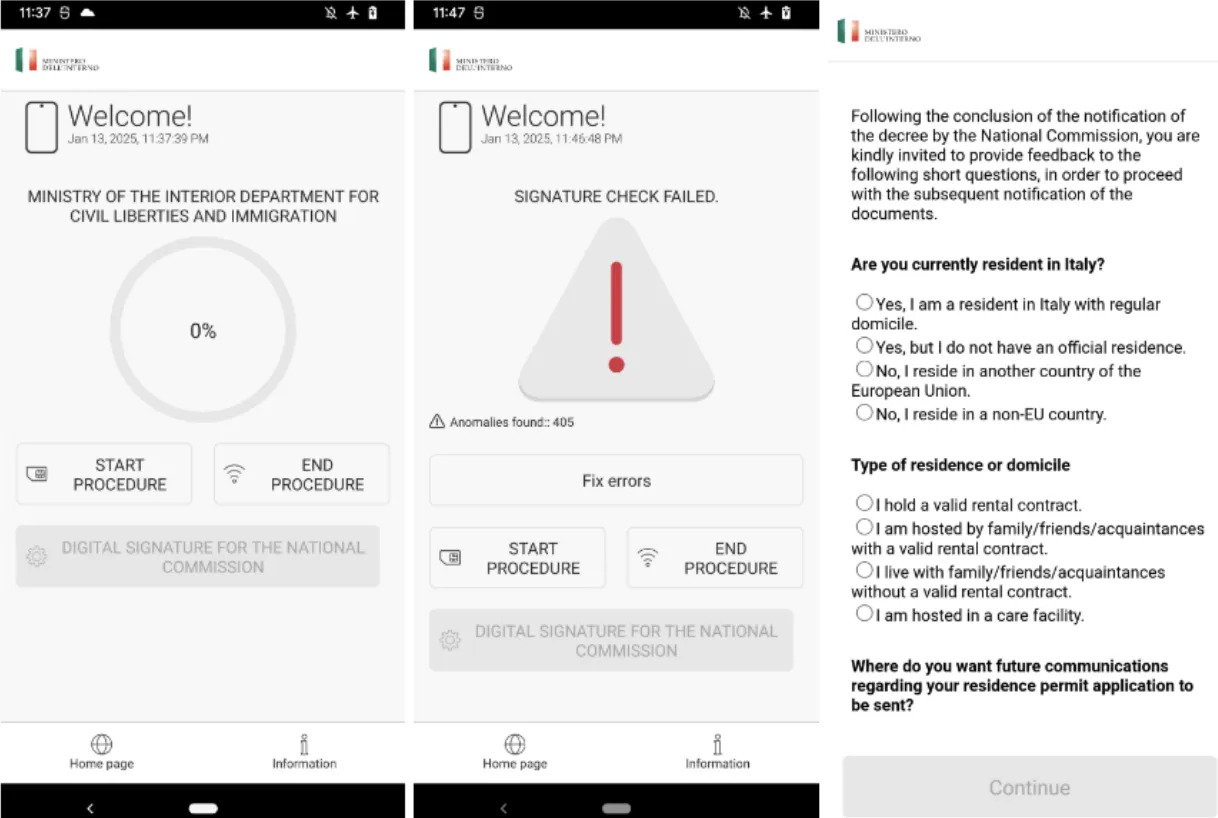
Once installed, the app linked to the real Poste Italiane website and to the Italian police’s page on residence permits. The Italian Interior Ministry’s logo appeared at the top, and the welcome screen named the department responsible for migration policy and asylum-seeker reception. Further screens referred to a formal notice from Italy’s National Asylum Commission, which decides whether to revoke someone’s international protection or whether that protection should end.
Screenshots of the FirmaDigitale app referring to a notice of a decision by Italy’s National Asylum Commission, the body that decides whether to revoke or end a person’s international protection
But the app was a lure. People installed it thinking they were completing the paperwork they needed to receive official documents. Instead, they gave the spyware broad access to their phones. Without their knowledge, the app could download and install components that let it listen in on conversations through the microphone, access contacts, call logs, files and text messages, track the phone’s location, record what happened on screen and intercept calls made over the internet.
The download site has been unreachable since 2025. The app may still be available on other websites.
A spokesperson for Italy’s State Police told IrpiMedia that «the FirmaDigitale app has no connection to the State Police website. Any links to the official website do not imply any affiliation». Poste Italiane did not respond to a request for comment.
Spyware made in Italy
Lookout and IrpiMedia found that FirmaDigitale was one of several apps used to spread the same spyware. Osservatorio Nessuno discovered it in April 2026 and named it Morpheus. In the version the group examined, the spyware posed as an app from Fastweb, an Italian telecom operator. It could also take over a WhatsApp account by tricking users into authenticating with their fingerprint or face. A fake screen made them think they were approving an update. In fact, they were giving the spyware full control of their WhatsApp account.
Other versions posed as apps from TIM and Iliad. The spyware campaign also used the names of two other mobile operators, PosteMobile and WindTre. The familiar brands made the apps look legitimate. However, all of them delivered the same spyware developed by IPS.
IrpiMedia asked the network operators whether they knew about the fake apps and what steps they planned to take given their consumer protection obligations. Iliad Italia was the only company to respond. «We are unaware of these apps or of any efforts to use our brand without authorization to spread spyware. To date, Iliad has received no reports or evidence of this through any of its contact channels, including social media (…). We will continue to use every tool at our disposal to combat unlawful conduct that could harm our users’ interests or Iliad’s reputation», the company’s press office said.
«Spyware like this relies on social engineering, manipulating people into taking one or more steps that lead to the spyware being installed on their devices», Kristina Balaam told IrpiMedia. Balaam analyzed Morpheus while working at Lookout and is now at the Citizen Lab, a University of Toronto research group that investigates abuses of surveillance technology, including cases involving spyware made by Paragon.
According to Balaam, social engineering makes these tools cheaper than more sophisticated zero-click spyware, which can infect a device without any action by the target. But they are just as effective. «In the past two years alone, we tracked 60 spyware campaigns that managed to compromise people’s devices without using zero-click techniques», she said.
IPS is one of several Italian companies developing these tools. In 2024, a study by the Atlantic Council, a US think tank, identified Italy as a global hub for the spyware industry alongside Israel and India. IrpiMedia has tracked at least nine established companies in the sector, including IPS, Innova, RCS, Area, Movia, SIO and its subsidiary ASIGINT, GR Sistemi and Negg Group.
In 2024, they generated a combined €214.4 million in revenue.
New companies are also entering the market. The latest IrpiMedia has identified is Robco, founded in 2023 in Caltanissetta, Sicily.
Spyware use surges in Italian criminal investigations
Italy is the main market for these companies. Spyware use in criminal investigations there has surged in four years. The latest figures from Italy’s Ministry of Justice show that the number of spyware targets rose by about 94 percent, from 2,894 in 2021 to 5,611 in 2025. In Germany, by comparison, judicial authorities authorized spyware use in 91 operations in 2024, of which 57 were carried out.
In recent years, a series of laws has given Italian investigators broad powers to use spyware. As a result, they can deploy it not only in cases involving organized crime and terrorism but also in cases involving offenses against the public administration and ordinary criminal offenses that carry a maximum sentence of more than five years. Since 2023, eligible offenses have also included facilitating irregular immigration, even without aggravating circumstances.
Mafia investigations accounted for the most spyware targets in 2025, with 2,930; ordinary criminal investigations followed closely, with 2,618. Terrorism investigations, meanwhile, accounted for just 63.
Spyware surveillance in Italy
Number of targets in criminal investigations by type of offence
IrpiData | Dati: ministero della Giustizia | Creato con: Flourish
«All it takes to use these investigative tools is an allegation of criminal association», said Eugenio Losco, a criminal defense lawyer who has spent years representing activists and union members in criminal proceedings.
Under Italian law, the offense involves forming or joining a group set up to commit crimes.
«Yet in recent years, people involved in social and labor campaigns have also been accused of this offense. That includes members of grassroots unions in Piacenza and members of a residents’ group in Milan. The latest case involves doctors who signed certificates stating that migrants were medically unfit to be held in immigration detention centers pending deportation», he added.
According to a cybersecurity researcher who asked to remain anonymous, at least five activists from Italy’s radical left have received links in recent months that could install spyware on their phones. The spyware was linked to Italian companies that work with law enforcement.
Another case involves Giorgia Linardi, the Italian spokesperson for the migrant rescue NGO Sea-Watch. On November 25, she said she had been monitored with zero-click spyware from at least May to August 2021.
Giovanni Battista Gallus, a lawyer specializing in technology and data protection law, warned that «when these tools are used, more attention should be paid to protecting the fundamental rights of both the people under surveillance and their contacts, whose communications are also intercepted. Yet Italy still lacks a comprehensive legal framework governing what spyware can do once it is installed on a phone».
There is a further problem. People under surveillance may never find out. Authorities are under no obligation to notify them if the investigation is closed without charges. And while the spyware must be deactivated when surveillance ends, the material it collected can remain in the prosecutor’s archive. The law allows people to ask for it to be destroyed, but that is «a right that is difficult to exercise if you don’t know you were under surveillance», Gallus said.
Who oversees the suppliers?
In theory, the products must meet certain technical standards. In practice, there is no provision for checking the quality of these services before they are used, and such checks would be difficult to carry out. Investigators rarely know the technical specifications of the software they use. Even when they have access to the source code, judicial authorities and law enforcement lack the technical expertise to verify that the software works as intended.
In 2019, a criminal investigation found that eSurv, an Italian spyware developer, had stored some intercepted material on its own servers instead of the servers installed at the prosecutor’s office. According to the cybersecurity group Security Without Borders, eSurv distributed its spyware through Google’s official app store, putting anyone who downloaded the app at risk of surveillance.
The trial of company officials on charges of unauthorized access to computer systems and unlawful data processing is still underway.
«Giving up this software would undermine many criminal investigations, including corruption cases», warned Marcello De Chiara, vice president of Italy’s National Association of Magistrates (ANM), which represents judges and prosecutors. «The ANM believes the current rules provide adequate safeguards for suspects and third parties. Prosecutors can apply to use the tool only when there are strong indications that a crime has been committed. They must explain why other investigative techniques would be ineffective, and a judge must authorize its use».
«The greater concern is the private companies that own and develop this software», De Chiara added. «We need rules that impose stricter standards for suppliers, establish a national register of accredited providers and make it easier to see who owns these companies». At present, each prosecutor’s office chooses its own suppliers.
However, the Italian Coalition for Civil Liberties and Rights (Cild) describes the fake Interior Ministry app uncovered by IrpiMedia as «a serious matter». «An essential service for asylum seekers was used as a lure to install extremely invasive tools that can access personal information, contacts and private communications. The consequences can extend to the people they communicate with», Andrea Oleandri, Cild’s co-director, told IrpiMedia.
The coalition is calling for answers about why the surveillance was carried out. «We need to understand why authorities considered it necessary to use these tools against people seeking international protection. We also need transparency about who authorized the operations, what they were meant to achieve, and what they found. Security must never justify normalizing widespread and indiscriminate surveillance. The use of these technologies must meet strict tests of necessity and proportionality and be subject to independent oversight. This is especially important when they are used against people in particularly vulnerable circumstances», Oleandri added.
EU journalists, activists and political opponents targeted by invasive spyware. From Italy to Greece, five stories expose how state secrecy and obstructed investigations deny victims justice, while the European Union looks the other way
Founded in Italy by a young hacker, Dataflow develops code to break into computers and smartphones. Since January, its operations in Israel have been led by Eyal Tsir Cohen, a former senior Mossad official who was shortlisted to lead Shin Bet in 2025
The system was being used without an adequate legal basis, in violation of privacy rules. Unpublished documents show that in May 2025, Italy’s Data Protection Authority asked the Interior Ministry to suspend it
Rosita Rijtano
Cookies on IrpiMedia
To provide the best experiences, we use technologies like cookies to store and/or access device information. Consenting to these technologies will allow us to process data such as browsing behavior or unique IDs on this site. Not consenting or withdrawing consent may adversely affect certain features and functions.
Functional
Always active
The technical storage or access is strictly necessary for the legitimate purpose of enabling the use of a specific service explicitly requested by the subscriber or user, or for the sole purpose of carrying out the transmission of a communication over an electronic communications network.
Third-party content
Shows video, audio and charts hosted by YouTube, Spotify and other services listed in the Cookie Policy. The providers receive your IP address and the page you are reading, and may use their own cookies, including for advertising and profiling.
Statistics
The technical storage or access that is used exclusively for statistical purposes.The technical storage or access that is used exclusively for anonymous statistical purposes. Without a subpoena, voluntary compliance on the part of your Internet Service Provider, or additional records from a third party, information stored or retrieved for this purpose alone cannot usually be used to identify you.
Marketing
The technical storage or access is required to create user profiles to send advertising, or to track the user on a website or across several websites for similar marketing purposes.